
The IEC 60601 4th edition transition is expected to significantly change how manufacturers demonstrate the basic safety and essential performance of medical electrical equipment and systems.
IEC 60601-1 Edition 4 remains under development and has not replaced the current IEC 60601-1 Edition 3.2 standard. Manufacturers do not need to transition their products today, but the direction of the new edition provides valuable insight into how medical electrical device safety, conformity assessment, and regulatory expectations may evolve.
Borderless MedDev has a direct connection to this work. Our Founder and Chief Regulatory Officer, Brodie Pedersen, serves as Vice Chair of IEC Subcommittee 62A and is directly involved in the development of the fourth edition of IEC 60601-1.
This involvement gives the Borderless MedDev team firsthand insight into the goals behind the revision, the challenges involved in restructuring the IEC 60601 family, and the implications manufacturers should begin considering.
As Brodie explains in his In Compliance Magazine article, “The IEC 60601 Family of Standards and the 4th Edition of IEC 60601-1,” the forthcoming edition represents much more than a routine update. It is a broad restructuring intended to make the standards family more consistent, easier to maintain, and better suited to modern medical electrical equipment, software, and systems.
Current status: IEC 60601-1 Edition 4 remains under development and is not currently mandatory. The concepts discussed in this article reflect the current direction of the project and may change before the final standard is published.
Why Is IEC 60601-1 Being Revised?
The IEC 60601 family of standards provides the international safety foundation for medical electrical equipment, software, and systems.
IEC 60601-1 establishes general requirements for basic safety and essential performance. Depending on the device, manufacturers may also need to comply with collateral standards that address broadly applicable subjects and particular standards that apply to specific categories of medical equipment.
Edition 3 of IEC 60601-1 was first published in 2005 and has since undergone two major amendments. During that period, medical technologies and healthcare delivery have changed substantially.
Modern medical devices increasingly incorporate:
Embedded software
Wireless communications
Network connectivity
Cloud-based services
Cybersecurity controls
Automated functions
Artificial intelligence
Remote monitoring
Interoperable systems
Home healthcare applications
These technologies introduce risks, system interactions, and development processes that were less prominent when Edition 3 was originally written.
To address these changes, IEC Technical Committee 62 and Subcommittee 62A are developing a new framework for IEC 60601-1. The objective is not simply to add more requirements. The project is intended to reorganize the General Standard and much of the broader standards family around a clearer and more maintainable safety framework.
Brodie Pedersen’s Role in Developing IEC 60601-1 Edition 4

Brodie Pedersen is not merely observing the development of the fourth edition from outside the standards process.
As Vice Chair of IEC SC 62A, Brodie is directly involved with the international subcommittee responsible for the General Standard and its related collateral standards. He also participates in the working groups developing future versions of the IEC 60601 family.
This work includes helping address questions such as:
How should existing General and Collateral Standard requirements be reorganized?
How should basic safety and essential performance be defined and applied?
How can process-oriented requirements support product conformity assessment?
How should software, usability, alarms, connectivity, and modern use environments be incorporated?
How can the standards family be maintained more efficiently in the future?
How should terminology be standardized across the General and Particular Standards?
Brodie’s direct participation connects Borderless MedDev’s regulatory and quality consulting work to the future direction of one of the medical device industry’s most important standards families.
Brodie provides a detailed account of the project’s structure, terminology work, collateral-standard integration, and current development activities in his IEC 60601 Edition 4 article for In Compliance Magazine.
What Is Expected to Change in IEC 60601-1 Edition 4?
The final standard has not yet been published, and individual requirements may change as the project moves through drafting, review, and voting.
However, several major objectives are already shaping the development of Edition 4.
A More Hazard-Oriented Structure
Edition 3.2 is organized through the General Standard, multiple collateral standards, and device-specific particular standards.
The Edition 4 design framework proposes reorganizing much of the General Standard around sources of hazards and other safety-related topics. This is intended to make the connection between hazards, requirements, risk controls, and conformity evidence easier to understand.
Potential groupings address subjects such as:
Electrical hazards
Mechanical hazards
Thermal hazards
Fire
Radiation
Biological and chemical hazards
Software-related hazards
Usability
Alarms
Environmental conditions
Medical electrical systems
Programmable functions
This structure is intended to support a more unified safety case rather than requiring manufacturers and conformity-assessment organizations to navigate requirements scattered across numerous documents.
The proposed clusters do not necessarily represent the final clause structure. They provide a framework for drafting and organizing the new edition.
Integration of Most Collateral Standards
One of the most significant goals for Edition 4 is the planned integration of most collateral-standard requirements into the General Standard.
Under Edition 3.2, manufacturers may need to apply IEC 60601-1 alongside collateral standards addressing subjects such as:
Electromagnetic disturbances
Radiation protection
Usability
Alarm systems
Physiological closed-loop controllers
Home healthcare environments
Emergency medical services environments
The current plan is to incorporate most of these requirements into a more cohesive General Standard.
This does not necessarily mean manufacturers will face fewer technical requirements. Existing requirements may instead be reorganized and incorporated into the General Standard based on their relationship to hazards, basic safety, essential performance, and intended-use conditions.
Integration may improve consistency and make future revisions easier to manage. It may also reduce situations in which General, Collateral, and Particular Standards are updated on different schedules.
Renewed Focus on Basic Safety and Essential Performance
Basic safety and essential performance will remain foundational concepts in Edition 4.
Basic safety addresses freedom from unacceptable risk caused by physical hazards during normal use and relevant fault conditions.
These hazards can include:
Electric shock
Mechanical injury
Excessive temperatures
Fire
Radiation exposure
Biological harm
Chemical harm
Essential performance generally concerns a clinical or diagnostic function where loss or degradation beyond limits specified by the manufacturer could result in an unacceptable risk other than one caused by a physical hazard.
Manufacturers should expect continued emphasis on clearly defining essential performance and connecting it to:
Risk analysis
Hazardous situations
Manufacturer-specified performance limits
Risk-control measures
Design requirements
Verification criteria
System-level test evidence
Brodie has emphasized that these concepts form the foundation of the medical device safety case. The fourth edition is expected to include additional rationale and clarification to support their consistent interpretation.
Product Testing and Organizational Processes
One of the challenges involved in developing Edition 4 is determining how a product safety standard should address activities that are highly dependent on organizational processes.
Software development, usability engineering, cybersecurity, risk management, and post-market monitoring cannot be fully evaluated through a single laboratory test.
At the same time, IEC 60601-1 is primarily used as a product conformity-assessment standard. The new edition must therefore establish how manufacturers can provide objective evidence that required processes have contributed to a safe and effective product without turning every conformity assessment into a comprehensive quality-system audit.
This reinforces the importance of maintaining a well-developed, standards-aligned quality management system.
Manufacturers need processes that consistently connect:
Design controls
Risk management
Software development
Usability engineering
Cybersecurity
Verification and validation
Supplier controls
Change management
Production information
Post-market surveillance
A mature quality system helps ensure that product safety is built into the device lifecycle rather than evaluated only at the end of development.
Software and Medical Electrical Systems
Software now plays a central role in many medical electrical devices and systems.
The proposed scope of Edition 4 addresses software integrated into medical electrical equipment. It also considers certain Software as a Medical Device used within a medical electrical system when that software contributes to basic safety or essential performance.
This distinction is important. Manufacturers should not assume that Edition 4 will automatically apply to every standalone medical software product.
Applicability may depend on:
The software’s intended use
Its role within the medical electrical system
Whether it contributes to essential performance
Whether its failure could create an unacceptable risk
Its interaction with medical electrical equipment
The final scope of the published standard
Manufacturers should be prepared to demonstrate how software-related risks are managed through:
Software architecture
Requirements development
Hazard analysis
Risk controls
Verification and validation
Configuration management
Change control
Problem resolution
System integration
Post-market monitoring
These activities should remain coordinated with applicable software lifecycle, usability, cybersecurity, and risk-management requirements.
Cybersecurity and Connected Medical Devices
Cybersecurity vulnerabilities can create safety risks when they affect the operation, availability, integrity, or performance of medical equipment.
A cybersecurity event could potentially:
Prevent delivery of therapy
Alter clinical information
Interrupt communication between system components
Disable or delay alarms
Restrict access to essential functions
Cause operation outside defined limits
Prevent the device from maintaining essential performance
Manufacturers should treat cybersecurity as both a security concern and a potential patient-safety concern.
Cybersecurity activities should be connected to:
Risk management
Software development
System architecture
Threat modeling
Verification and validation
Vulnerability management
Update procedures
Incident response
Post-market surveillance
The final Edition 4 cybersecurity requirements have not yet been published. Manufacturers must continue following the regulations, standards, and regulatory guidance currently applicable to their devices and target markets.
Artificial Intelligence and Automated Functions
Medical devices increasingly use artificial intelligence and varying levels of automation to support diagnosis, monitoring, treatment, and clinical decision-making.
AI-enabled functions do not eliminate the need to define intended performance, foreseeable failure modes, acceptable limits, risk controls, and objective acceptance criteria.
They can also introduce additional considerations involving:
Training and validation data
Performance across patient populations
Data quality
Model updates
Performance drift
User reliance on automated outputs
Human oversight
Failure detection
System interactions
Post-market monitoring
Manufacturers developing AI-enabled medical electrical equipment should evaluate whether failures or performance degradation could affect basic safety or essential performance.
Edition 4 is expected to provide a framework better suited to modern automated technology, but manufacturers should not treat draft concepts as finalized AI requirements.
Healthcare Beyond the Hospital
Healthcare continues to expand beyond traditional hospitals and clinics.
Medical equipment is now routinely used in:
Private homes
Assisted-living facilities
Ambulances
Emergency vehicles
Outpatient environments
Remote-care settings
Other locations with limited clinical infrastructure
These environments may be less controlled than a hospital and may involve users without professional medical or technical training.
Manufacturers may need to evaluate:
Use by patients and caregivers
Use by other lay operators
Children and pets
Power quality and grounding
Temperature and humidity
Storage and transportation
Wireless interference
Internet availability
Cleaning and maintenance
Emergency transportation
Availability of technical support
Use with consumer or non-medical equipment
Intended users and use environments should be reflected in the risk-management file, usability engineering process, labeling, product specifications, verification strategy, and post-market plan.
IEC 60601-1 Edition 3.2 Compared With Edition 4
| Aspect | Edition 3.2 (Current) | Edition 4 (Forthcoming) |
|---|---|---|
| Standard Structure | Base standard plus separate collateral standards for EMC, usability, alarm systems, home healthcare, and emergency medical services | Collateral standards integrated into a single General Standard, organized around sources of hazard and risk |
| Core Safety Concepts | Basic safety and essential performance are defined, with limited rationale for building organizational risk systems | Same core concepts retained, with expanded rationale and guidance for stronger, better-documented safety cases |
| Software & Connectivity | Addressed only indirectly, largely through general risk management references | Expanded requirements for embedded software, Software as a Medical Device (SaMD), mobile applications, and connected technologies |
| Cybersecurity | Not addressed as a distinct safety consideration | Treated as a core safety consideration directly tied to essential performance |
| Care Environments | Home healthcare and emergency medical services covered in separate collateral standards | Requirements for homes, ambulances, and other non-traditional care settings built into the General Standard itself |
| Conformity Assessment | Manufacturers demonstrate compliance against multiple standards separately | A single, more unified method for demonstrating conformity across the standard family |
| Current Status | Active edition, currently in force and enforced by regulators and test houses | In development by IEC Technical Committee 62 and Subcommittee 62A; publication still several years away |
| What Manufacturers Should Do | Continue meeting current requirements under the active edition | Begin strengthening risk management practices and software and cybersecurity processes, and reassessing essential performance definitions, now |
This comparison represents the current direction of the Edition 4 project rather than a final clause-by-clause assessment.
What Will the IEC 60601 4th Edition Transition Look Like?
The IEC 60601 4th edition transition is unlikely to occur through one worldwide compliance deadline.
Publication by IEC will be only one step in a broader process. The practical transition may involve:
Completion of drafting and committee review
Committee voting and approval
Publication by IEC
Adoption by national and regional standards bodies
Recognition by regulatory authorities
Implementation by testing laboratories and certification bodies
Revision of applicable Particular Standards
Manufacturer-specific product transition plans
Different countries and regulatory regions may adopt or recognize the new edition at different times. National deviations may also affect how the requirements are applied.
Manufacturers should not assume that publication of Edition 4 will immediately invalidate all Edition 3.2 test reports or certifications.
The treatment of existing products may depend on:
Target markets
Regulatory recognition dates
Certification-body policies
Product modifications
New regulatory submissions
Applicable Particular Standards
Device risk
Quality-system procedures
Post-market findings
New products, significantly modified devices, and previously certified legacy devices may follow different transition pathways.
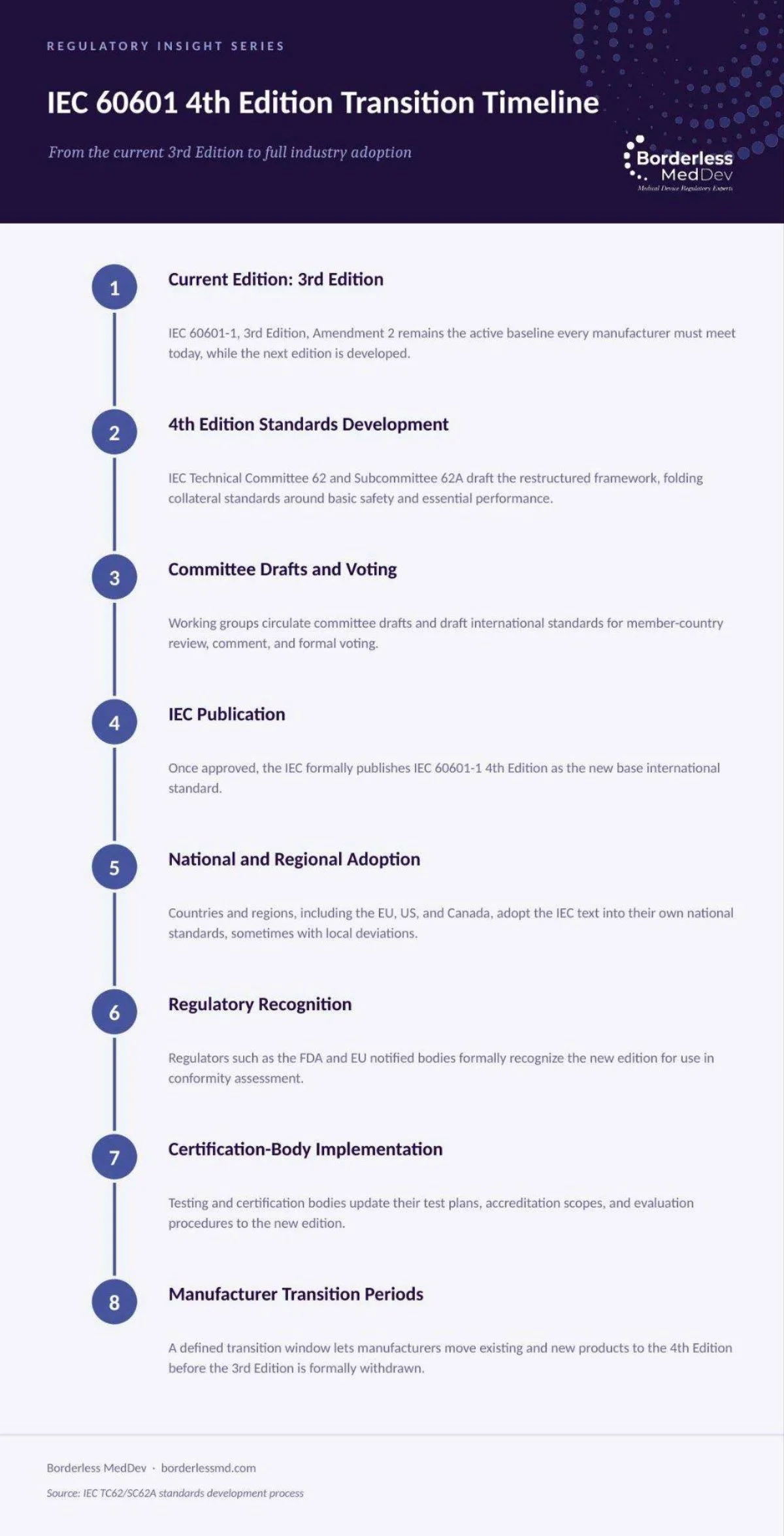
Caption: Illustrative transition process. Dates and adoption requirements may vary by jurisdiction and may change as Edition 4 development progresses.
How Manufacturers Can Prepare for IEC 60601-1 Edition 4
Manufacturers should continue designing and testing products against the standards currently required in their target markets.
Preparing for Edition 4 should not mean delaying current compliance work or treating unpublished proposals as final requirements. It should mean strengthening the systems and documentation that support current compliance while making a future transition easier to manage.
Monitor Standards Development
Assign responsibility for monitoring:
IEC 60601-1 Edition 4
Applicable Collateral Standards
Applicable Particular Standards
National adoption activity
Regulatory recognition
Certification-body policies
Test-laboratory guidance
Brodie Pedersen’s direct participation in the development of Edition 4 also allows Borderless MedDev to interpret emerging changes within the broader context of product development, quality systems, conformity assessment, and regulatory submissions.
Confirm the Current Standards Strategy
Develop or update a standards-applicability matrix for each product.
The matrix should identify:
The applicable edition of IEC 60601-1
Collateral Standards
Particular Standards
National deviations
Software lifecycle standards
Usability standards
EMC requirements
Cybersecurity requirements
Risk-management requirements
Market-specific regulatory expectations
This creates a baseline for evaluating the future differences introduced by Edition 4.
Reassess Essential Performance
Review whether essential performance is clearly:
Identified
Justified
Connected to hazardous situations
Linked to risk controls
Expressed through measurable performance limits
Verified under relevant normal and fault conditions
Addressed in system-level testing
Poorly documented essential-performance definitions can create difficulties under both the current and future editions.
Strengthen Risk-Management Traceability
Manufacturers should be able to trace:
Hazards
Foreseeable sequences of events
Hazardous situations
Potential harms
Risk evaluations
Risk controls
Design requirements
Verification evidence
Residual-risk evaluations
Production information
Post-production information
Clear traceability between risk-management decisions and engineering evidence will support current submissions as well as future transition assessments.
Review Software Lifecycle Evidence
For software-based devices, assess whether the technical documentation adequately addresses:
Software safety classification
Architecture
Interfaces
Requirements
Risk controls
Traceability
Verification
Known anomalies
Configuration management
Third-party software
Network dependencies
Update processes
System integration
Software documentation should make clear how each component contributes to basic safety and essential performance.
Review Cybersecurity Processes
Confirm that cybersecurity activities are integrated with:
Risk management
Software development
System architecture
Threat modeling
Verification and validation
Vulnerability management
Update procedures
Post-market surveillance
Incident response
Evaluate Intended Users and Environments
Confirm that the technical documentation accurately represents who will use the device and where it will operate.
Review whether assumptions about trained users, controlled electrical power, stable networks, environmental conditions, cleaning, maintenance, and technical support remain valid.
Strengthen the Quality Management System
Many of the technical areas relevant to Edition 4 depend on repeatable organizational processes.
A strong medical device quality management system can help manufacturers establish and maintain the procedures, records, responsibilities, and traceability needed to support:
Design controls
Risk management
Software documentation
Cybersecurity
Usability
Verification and validation
Supplier management
Change control
Post-market monitoring
Consider Future Regulatory Submissions
Changes to IEC 60601-1 may eventually affect the standards and evidence used in regulatory submissions.
Manufacturers planning a new device, a significant product modification, or a future submission should consider how their current testing and documentation strategy will support both present requirements and future standards transitions.
Borderless MedDev helps companies develop regulatory strategies and prepare complete submission portfolios through our FDA submission preparation and filing services.
Avoid Premature Redesign
Manufacturers should not redesign a product solely around draft structures or anticipated clauses.
A better approach is to identify areas where stronger documentation, traceability, architecture, and lifecycle controls provide value under the current standard while also making future gap assessments more efficient.
Frequently Asked Questions About IEC 60601-1 Edition 4
Is IEC 60601-1 Edition 4 currently mandatory?
No. Edition 4 remains under development. Manufacturers should continue applying the standards and editions currently required by regulators, target markets, certification bodies, and applicable Particular Standards.
When will manufacturers need to comply?
No universal compliance date has been established.
Transition timing may depend on:
IEC publication
National or regional adoption
Regulatory recognition
Certification-body policies
Applicable Particular Standards
Device type
Product changes
Target markets
Will the Collateral Standards disappear?
The current plan is to integrate most Collateral Standard requirements into the revised General Standard.
This does not mean the technical subjects addressed by the Collateral Standards will disappear. Most are expected to be reorganized within the new structure.
The final organization may change as Edition 4 continues through development.
Will Edition 4 apply to standalone medical software?
Not necessarily.
The proposed scope includes software integrated into medical electrical equipment and certain Software as a Medical Device used within a medical electrical system when that software contributes to basic safety or essential performance.
Final applicability will depend on the published scope and the role of the software within the system.
Will existing IEC 60601 certifications remain valid?
Publication of a new edition does not automatically determine the status of every existing certification or test report.
The answer may vary according to:
Jurisdiction
Regulatory policies
Certification-body requirements
Product modifications
Submission type
Applicable Particular Standards
Established transition periods
Should manufacturers design new products to Edition 4 now?
Manufacturers should not treat unpublished concepts as final requirements.
New products should continue to comply with currently applicable standards. Companies can and shouldl prepare by strengthening risk management, essential-performance definitions, software lifecycle documentation, cybersecurity processes, usability engineering, quality systems, and technical traceability.
How Borderless MedDev Helps Manufacturers Prepare
Borderless MedDev brings an uncommon level of direct standards-development experience to IEC 60601 compliance and transition planning.
As Vice Chair of IEC SC 62A and a leader involved in the development of IEC 60601-1 Edition 4, Brodie Pedersen understands both the technical goals of the revision and the practical challenges manufacturers face when converting standards requirements into product evidence.
Borderless MedDev can help with:
IEC 60601 standards-applicability reviews
Edition 4 transition-readiness assessments
Essential-performance evaluations
Risk-management file development
Software lifecycle process reviews
Cybersecurity process integration
Intended-use environment assessments
Technical documentation
Quality management system development
FDA regulatory strategy
FDA submission preparation and filing
Because Edition 4 remains under development, preparation should not mean prematurely designing to unpublished requirements. It should mean building the organizational systems, regulatory strategy, and technical evidence needed to comply today while making a future transition more controlled and predictable.
Manufacturers can learn more about the developing standard by reading Brodie Pedersen’s In-Compliance article, “The IEC 60601 Family of Standards and the 4th Edition of IEC 60601-1.”
Planning a new medical electrical device or evaluating an existing product platform? Contact Borderless MedDev to discuss an IEC 60601 transition-readiness assessment.